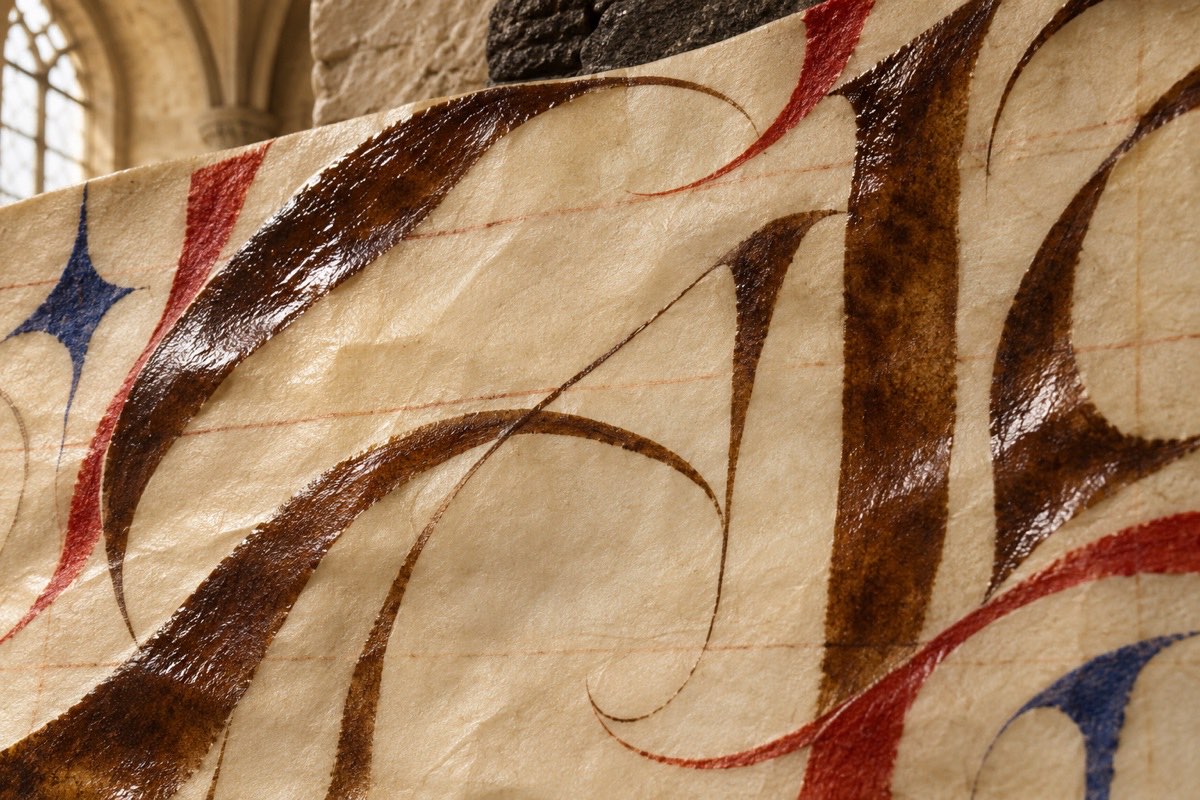
Carolingian minuscule: the script that shaped our letters
Carolingian minuscule became the calligraphic standard of the Middle Ages, bringing clarity and consistency to copied books. How did it develop, who shaped it, and where did they work? This guide explores those questions and traces the script's path from manuscripts to modern typefaces.
What Is Carolingian Script and Where Did It Come From?
The script developed in stages. An early version emerged in the scriptorium of the Benedictine abbey of Corbie, about 150 km north of Paris. A later version, developed in the scriptoria of Tours, was used in widely circulated Bibles and gospel books.
The script developed partly under Charlemagne's patronage. Alcuin of York headed his palace school and the scriptorium at Aachen from 782 to 796. Later, as abbot, he rebuilt the scriptorium at Marmoutier near Tours.
The Main Advantage of Carolingian Minuscule
The main advantage of Carolingian minuscule was legibility. It used spaces between words and more punctuation. Letter case followed a consistent pattern: capitals in titles, mixed case in subtitles and lower case in the main text. The letters were uniform, rounded and easy to distinguish.
It went on to replace Insular script in Britain and Ireland in the 11th and 12th centuries, and Visigothic script on the Iberian Peninsula.
Examples of Carolingian Minuscule
Surviving manuscripts offer the best way to study the script. The Godescalc Evangelistary, completed in 783, is regarded as the first manuscript written in it. The Ada Gospels from Aachen provided classic models. These two works are useful starting points for seeing the script in practice.
What Did Monks Do in a Scriptorium?
A medieval scriptorium was a monastery's workroom for copying and illuminating manuscripts. Not every monastery had a separate room for this work. Scribes often worked in the library or in their cells, so "scriptorium" can describe a place's function rather than a distinct room.
Monks' tasks in a scriptorium varied with the stage of the work. Some smoothed and chalked the parchment, others ruled it and copied the text, and others illuminated the finished pages. Sometimes a single monk carried out every stage.
Monks copied texts including the Latin Bible, known as the Vulgate, and commentaries and letters by the Church Fathers. From the early 13th century, lay workshops developed alongside monastic scriptoria. Professional scribes in these workshops worked to order.
From Minuscule to Today's Typefaces
The script's influence continued beyond the Middle Ages. In the 10th and 11th centuries it gradually developed into blackletter. In the 14th century Italian humanists used it as the basis for humanist minuscule. Carolingian minuscule is therefore an indirect ancestor of most of today's Latin typefaces, including Times New Roman. Return to the history of Western calligraphy to explore later developments.