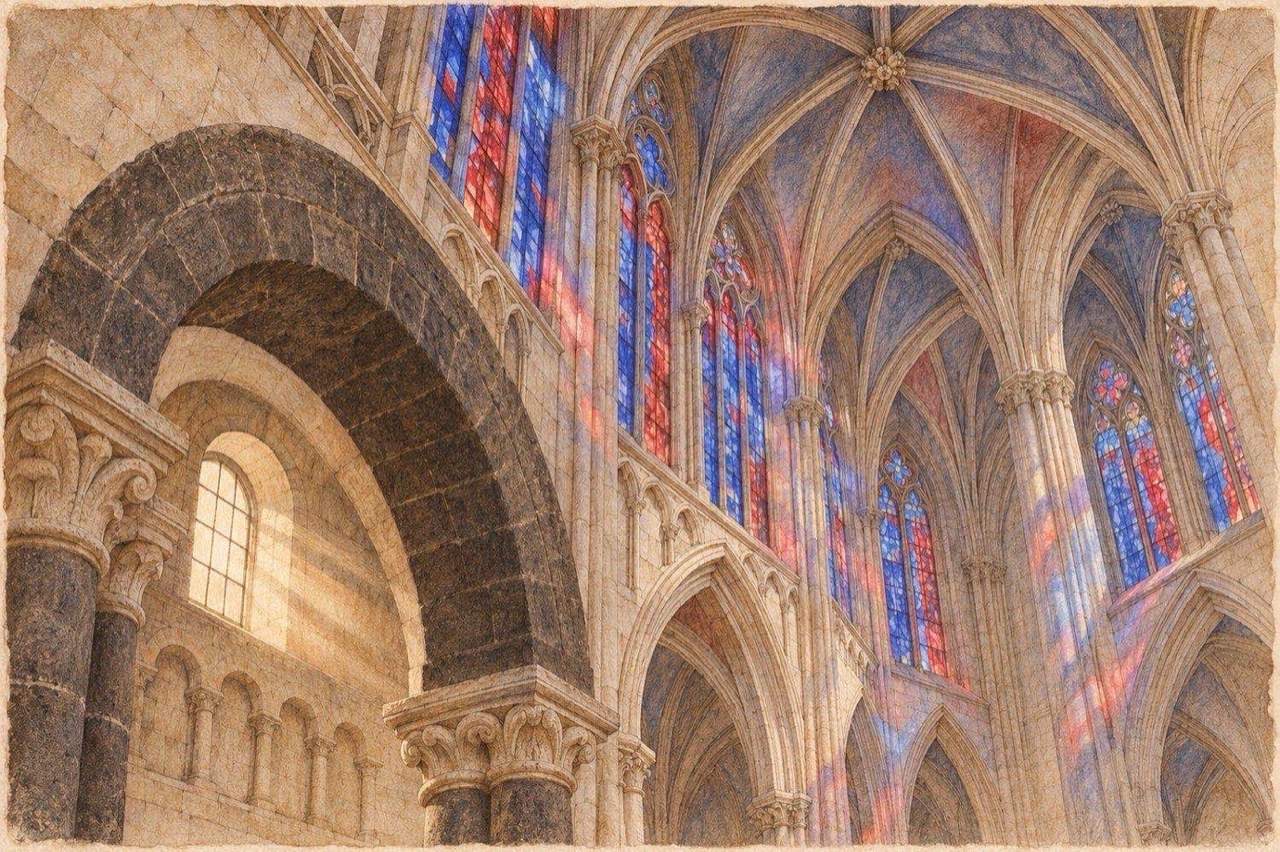
Romanesque vs Gothic architecture: round arch, pointed arch
Romanesque and Gothic are two successive styles of medieval architecture, most easily distinguished by their arch shapes and structural proportions. Romanesque dominated in the 11th and 12th centuries, and Gothic from the end of the 12th century to the 16th. This guide explains how to recognise each style at a glance and briefly traces the origins of Gothic. Start with the arches, walls and windows, then look at how the building is constructed.
Which Came First, Romanesque or Gothic?
Romanesque came first. Gothic grew out of it and gradually replaced it, which explains the close relationship between the styles. The change did not happen overnight. Some regions of France adopted Gothic more slowly, so provincial churches continued to be built in the heavy Romanesque style even as pointed window arches became fashionable.
Buildings in the same area can therefore combine features of both styles. This mixture is an important clue when examining historic buildings. Judge the style by the structure as a whole, considering its mass, walls, vaults and windows together rather than relying on a single detail.
Romanesque vs Gothic Arches
The clearest difference is the shape of the arch. Romanesque arches are semicircular, while Gothic arches are pointed. This detail usually identifies the style of a portal, arcade or window opening. Look for a rounded top or one that meets at a point.
Romanesque buildings rest on thick walls and piers and have small windows, giving them a simpler, more massive appearance. Romanesque and Gothic windows differ in both shape and size. Large stained glass windows with tracery are characteristic of Gothic, in contrast to the small windows of Romanesque buildings. Windows can therefore help you identify a building's period.
Romanesque vs Gothic Architecture in Construction
Gothic has four characteristic elements: pointed arches, rib vaults, flying buttresses and large stained glass windows with tracery. Pointed ribs made it possible to adjust the height of the diagonal and transverse ribs. This distinguishes Gothic construction from massive Romanesque structures supported by thick walls and piers.
The first pointed ribs appeared in the vaults of Durham Cathedral in 1128. The earliest pointed vault in France is in the narthex of the church of La Madeleine at Vézelay and dates from 1130. Both dates precede the rebuilding of the choir at Saint-Denis, discussed in the next section. Pointed vaults thus appeared before the first building regarded as Gothic.
In practice, a few simple questions can help you identify the style. What shape are the arches over the portal and windows? How thick do the walls look, and how large are the windows? Does the vault have ribs, and are flying buttresses visible outside? Each answer offers a clue, and three consistent clues allow a reasonably confident conclusion.
Where Did Gothic Come From?
The abbey of Saint-Denis near Paris, whose choir was rebuilt from 1140 to 1144, is considered the first Gothic building. Gothic originated in the Île-de-France and Picardy. In the Middle Ages, it was called opus Francigenum, "the French work". The name "Gothic" was initially a term of contempt, unlike its meaning today.
Is Notre-Dame Gothic?
Yes, Notre-Dame Cathedral in Paris is a Gothic building.
How to Remember the Differences
The distinction is simple: Romanesque has semicircular arches, thick walls and small windows; Gothic has pointed arches, rib vaults, flying buttresses and large stained glass windows. When visiting a building, look first at the arches, then the walls and windows, and finally the vaults. Each offers a clue to its style. See the Romanesque priories of Forez.